Purpose and overview of the framework
For many countries, routine programmatic and surveillance data do not capture all desired data for TB program planning and decision making, therefore, TB data-related surveys, assessment and tools beyond routine surveillance systems are critical to fill data gaps, but can require substantial resources such as staff time and funding. In the context of limited resources, improved coordination and better aligned timing of implementing TB data tools are necessary to optimize the use of their findings for strategic and programme planning and funding applications.
Hence, the framework was developed to serve two main purposes.
- To help TB programmes identify additional surveys, assessments, and tools needed beyond routine surveillance, based on data/information gaps usually identified during the National Strategic Plan (NSP) development process.
- To support prioritization of these tools by considering the feasibility of implementation and the relevance of the findings, as well as planning the appropriate timeline and sequence.
The framework is intended to be used alongside the WHO Compendium of TB data and evidence-related tools for program planning, second edition and People-centred framework for tuberculosis programme planning and prioritization and is aligned with WHO's Guidance for national strategic planning for tuberculosis.
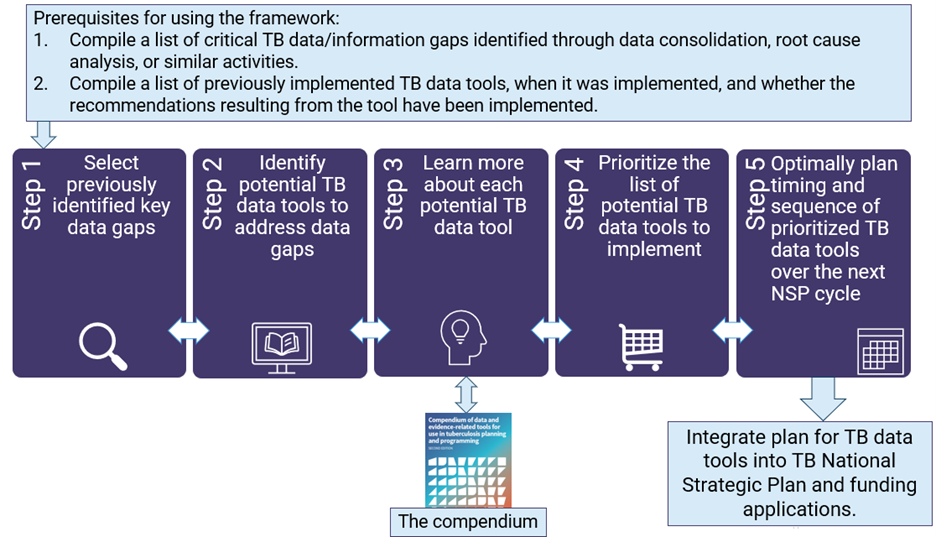
Steps 1-3: Establish wish list of tools to address key data gaps
Use the key data gaps and potential tools interactive boxes below to complete steps 1-3.
Step 1: Select your country's previously identified data/information gaps from the drop-down list in the key data gaps box, organized by area. You can select one or more than one gap at a time.
Step 2: Potential data tools that could address the selected data gaps and questions from the key data gaps box will populate in the potential tools box. Start to identify and write down your wish list of potential tools.
Step 3: Learn more about each potential data tool and consider the prerequisites and limitations of the tool by clicking on a tool. Refer to the second edition of the compendium for more information. Refine your wish list of potential tools as needed.
Save: you can save your progress at any point in the process by clicking on the Save button. Please note that in order to save your progress, your browser must have browsing history function turned on. The save function cannot be used in private browsing mode, and clearing your browser history/cache will also clear your saved work.
Generate hyperlink: a hyperlink can be generated for your output, which can be shared with colleagues. When clicking the generated hyperlink, a page will open to the completed output. Several hyperlinks can be generated for different scenarios, which can be returned to at different points for comparison and facilitate discussions for different scenarios as needed.
Key Data Gaps
(select one or more key data gaps or questions)Potential Tools
(click on a tool to show more information)Step 4: Prioritize tools in wish list
Now that you have your wish list of tools, follow the prioritization steps and use the prioritization diagram to consider the different factors for implementing a tool and prioritize your wish list of tools. You can use a whiteboard or flip chart and sticky notes for this prioritization activity.
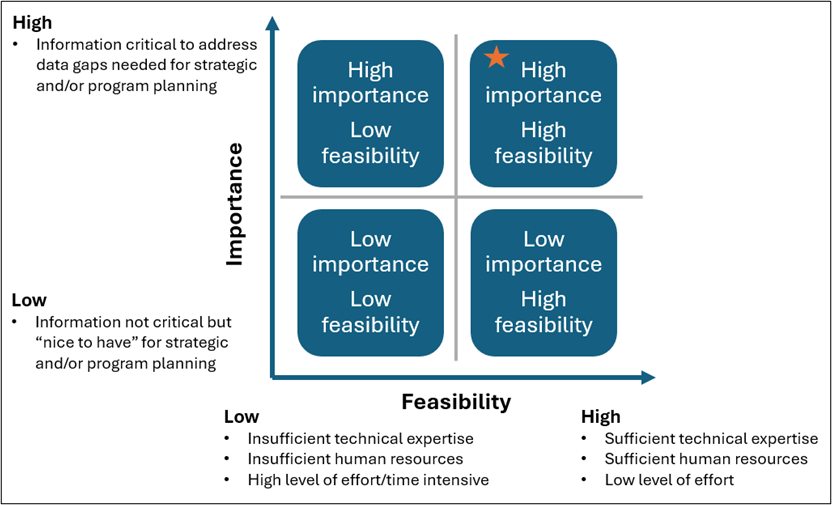
- Draw the outline of the prioritization diagram on a flipchart/whiteboard.
- Write each of the tools on your wish list on a sticky note (one tool per sticky note).
- Place each sticky note along the vertical line in the middle of the diagram based on how important/critical the tool is to implement to fill the data gap (see diagram below for example). The most important tools will be at the top, and the less important tools will be at the bottom. When thinking about the data importance of a tool, consider:
- Will findings address an important data gap for strategic and/or program planning?
- Will findings/information lead to actionable recommendations? And if a tool has been implemented before, were previous recommendations implemented and would you expect to see a change in findings if you were to repeat the tool?
- For reference:
- High importance = findings from the tool are critical to address data and evidence gaps needed for strategic and/or program planning and will result in actionable recommendations.
- Low importance = information resulting from the tool is not critical, but “nice to have” for strategic and/or program planning.
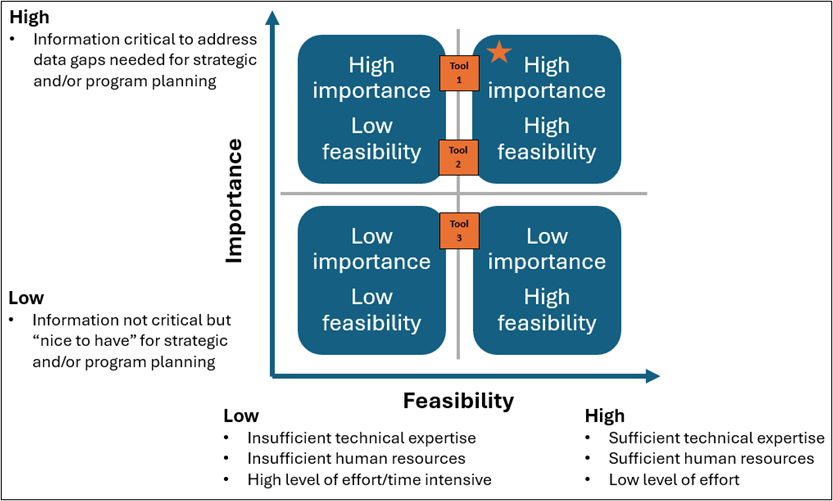
- Once all the tools on your wish list have been ranked by importance, you will now rank them by technical and implementation feasibility. This can be done by moving the tools left or right (see diagram below for example). Do not take feasibility of funding into account yet, this will come at a later step.
Move each of the sticky notes with a tool on it to the right or to the left in the diagram based on how feasible it is to implement in the next national strategic planning (NSP) cycle. When thinking about feasibility, consider:- How much human resources and time are needed?
- Is the structure and/or equipment in place to implement the tool/survey?
- Is there sufficient in-house/in-country expertise or will implementation of the tool require external technical assistance?
- Will implementation have a negative impact on routine program activities due to the amount of time that will be required by TB program staff?
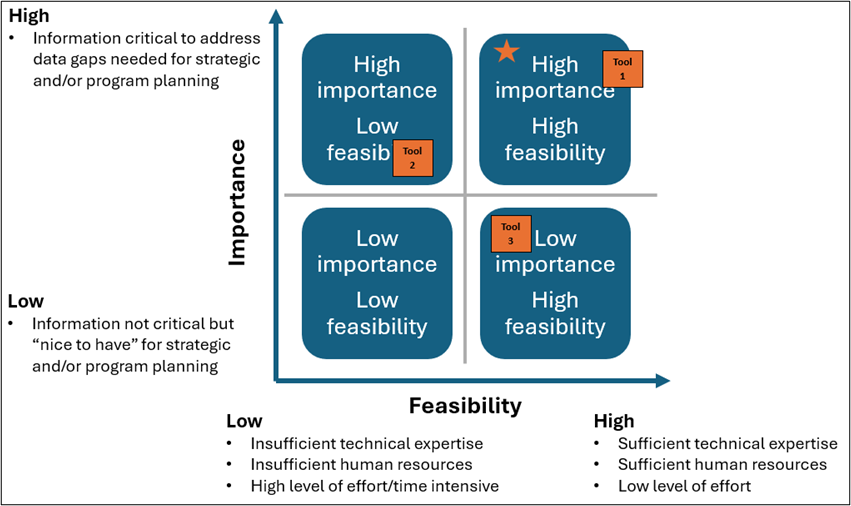
- Each of the tools on your wish list should now be in one of the four quadrants in the diagram.
- The tools in the top right quadrant are assigned high importance and high feasibility, making these tools the highest priority.
- The tools in the bottom left quadrant are assigned low importance and low feasibility, making these tools the lowest in priority. This does not mean you should not implement these tools, but they have lower priority and if funding is limited, they may not be implemented in the next NSP.
- Review the placement of all the tools in the quadrants as a group and think about the additional considerations below (and others that are relevant to your country). Then discuss whether the prioritization of each tool needs to be readjusted.
- Other considerations/factors for prioritization: e.g. funding availability (domestic and donor funding), country goals/context/policies, health system context, etc.
- Tool dependencies: does a tool depend on data from another tool (e.g. modelling requires good data input)?
- Tool complementarity or potential combination of tools: If funding is limited, could you implement two tools on your list at the same time using shared resources (e.g. same data collection team, adding aspects/questions from one tool into another tool)?
- Repeat implementation of tools: review the list of previously implemented tools you have compiled in preparation for using the framework. Discuss and decide whether a tool needs to be repeated based on when it was last implemented, whether the recommendations resulting from the tool have been implemented, or if enough time has passed to measure a difference if that is the aim. If recommendations have not been implemented, then repeating the tool may result in similar findings.
- Based on the prioritization of the tools, discuss and decide which tools are realistic to include in your upcoming NSP and funding applications. You can start by including tools ranked as highest priority (upper right quadrant of the diagram), then add those ranked in either the upper left quadrant or lower right quadrant if there are not already too many tools included in the NSP. You can also think about what is needed to move tools from lower to higher feasibility and what may have to be incorporated in the NSP for that to happen, especially for tools with high importance but low(er) feasibility.
Here is a hypothetical example of how a TB programme of a fictitious country prioritized their wish list of tools.
This provides the justification, based on the fictitious context, as to why certain tools were prioritized over others. This example is for demonstrative purposes only and should not be taken as suggestion on how to prioritize the tools in the example, as it will be dependent on individual country contexts:
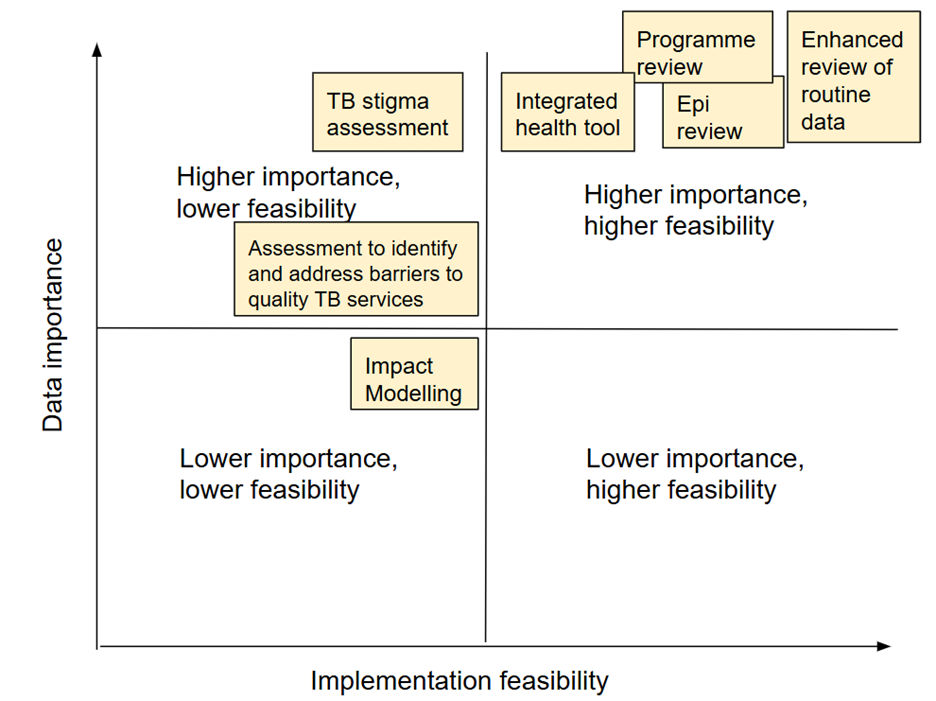
Enhanced review of routine data, programme review, epidemiological review, and integrated health tool were assigned higher importance and higher feasibility, making these tools the highest priority to implement. These tools were prioritized because the outputs from the tools were deemed essential by the TB programme for national strategic planning, and are considered highly feasible since the TB programme already has technical expertise and funding in place for implementation.
TB stigma assessment and assessment to identify and address barriers to quality TB services were assigned higher importance by the TB programme, as the programme does not have sufficient data to understand and address TB stigma and barriers to accessing quality TB services. However, due to lack of technical expertise and necessary funding to hire technical experts, the TB programme assigned these activities a lower feasibility to implement. While the TB programme is still interested in filling these data gaps, these activities were considered as lower priority relative to other tools, given the limitations in feasibility, until funding or technical expertise is sourced.
Impact modelling was assigned lower importance by the TB programme relative to the other tools, because it was deemed not critical for the fictious country to implement during this cycle of national strategic planning, though the projections (outputs) would be nice to have for future planning. Additionally, the TB programme assigned impact modelling lower feasibility, as they agreed, through consultation, that they are missing key data to parameterize the model to generate robust projections, and funding is not readily available to engage the necessary technical expertise. Therefore, the TB programme decided to focus on strengthening the necessary data (leveraging on the epidemiological review and programme review) and defer the use of impact modelling to investigate scenarios for the development of their elimination roadmap, for which discussions are still in early stages.
Step 5: Establish timeline for implementing prioritized tools
Now that you have your prioritized list of data tools, use the Gantt chart below and the timing and sequence recommendations for each tool (information provided in the second edition of the compendium) to optimally plan the implementation of the prioritized data tools over your upcoming strategic plan period.
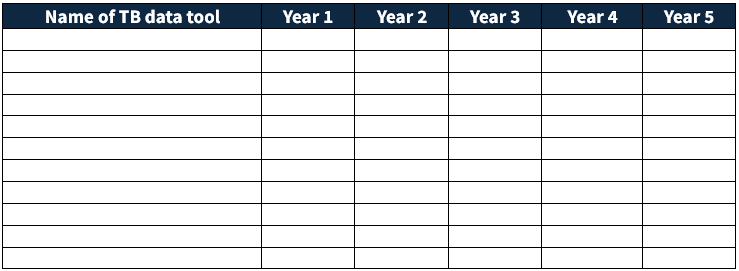
- Think about the optimal timing and additional considerations related to the timing and duration of implementation for each tool.
- Using the timing recommendations for each tool (information provided in the second edition of the compendium), determine whether the tools on your prioritized list are feasible to implement within the next 3-5 year strategic plan period.
- Revise your prioritized list of tools as needed, given the timing considerations.
Lastly, integrate your plan for implementing data tools into your upcoming strategic plan and funding applications.
Here is a hypothetical example of how a TB programme of a fictitious country established a timeline for implementing their prioritized tools.
This example continues from the example presented in Step 4. The TB programme of the fictitious country planned for the implementation of their prioritized tools throughout the next 5 years of their NSP and presented the plan in the form of a Gantt chart. The justification, based on the fictitious country context is provided. This example is for demonstrative purposes only and should not be taken as concrete instructions as to when these tools should be implemented, as this is dependent on individual country context.
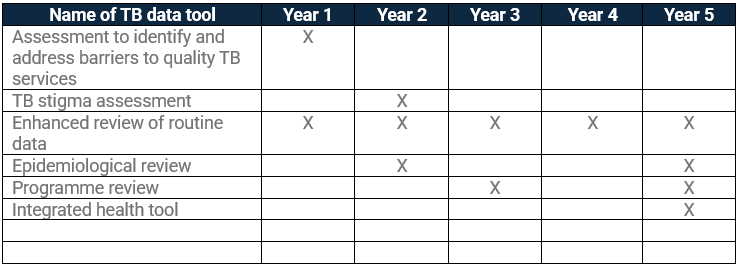
The TB programme plans on implementing an assessment to identify and address barriers to quality TB services and TB stigma assessment during years one and two respectively. These are planned early in the NSP period, as the programme is already anticipating being able to secure a mix of domestic and donor funding for implementing the assessments and hiring of technical experts. Each assessment takes approximately six to nine months from planning to validating findings and recommendations.
The TB programme plans to do an enhanced review of routine data on an annual basis to investigate gaps in the TB care cascade as this is a routine activity typically done during annual reviews. The conduct of an epidemiological review is planned during years two (quarter 4) and five (quarter 2) ahead of the mid-term and end-term programme reviews planned for years three and five. The country then plans on using the integrated health tool during quarter 4 of year 5, aligning with the timing of the next national strategic plan development period.
Based on the prioritization exercise (step 4), the TB programme decided not to plan for impact modelling during this five-year cycle and will reconsider it for the next strategic planning period for the development of the TB elimination plan, as agreed during the prioritization exercise.